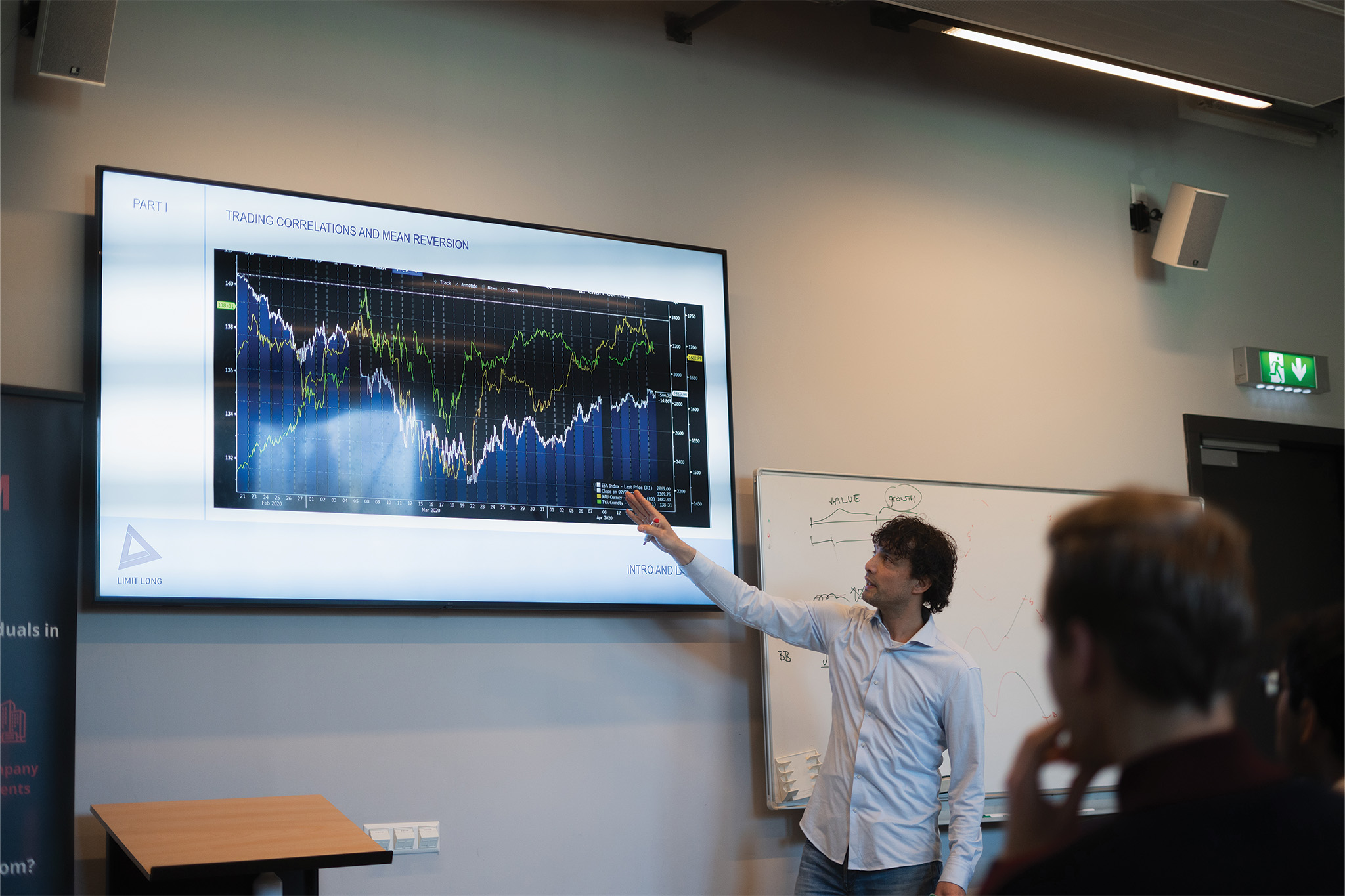
On March 11th, we hosted an incredibly engaging collaboration event: “Options Deep Dive” together with the Amsterdam Investment Club and Prometheus Capital. The classroom was filled with a mix of students from different levels interested in quantitative finance, investing, and trading. Although the session was scheduled for two hours, judging by the attention in the room, it could easily have lasted longer, all thanks to our speaker Vincent Vis and his incredible energy and passion. He clearly had a lot to say.
Our guest is not someone who approaches markets purely from theory. Vincent has worked at leading, top-tier firms in the options and market-making world. He started his career as a mathematician and moved into financial markets, entering the industry straight away through Optiver in 2011. Over the years, he also traded at firms such as IMC Trading and Maven Securities. Alongside trading, Vincent also served as an in-house trainer at these firms, teaching new traders how to understand volatility, options pricing, and risk management.
Today, he continues working within the financial industry as a trainer and advisor through his venture LimitLong, while also educating retail investors through the Dutch platform DeAandeelHouder.nl.
From the very first minutes of the event, it was clear this would not be a standard lecture. The session was interactive, full of questions, real trading examples, and occasional remarks about the realities of the industry. The slides were there, but the discussion frequently moved beyond them. In short, the session offered a rare glimpse into how trading actually works in practice.
One of the first questions Vincent asked the room was deceptively simple:
When you place a trade in the market, who do you think you are trading against?
Many people imagine financial markets as a place where individuals trade with each other. In reality, this is rarely the case.
In most Western markets, roughly 90% of trading volume comes from institutions - banks, hedge funds, market makers, pension funds, and asset managers. Retail traders make up only a small share of the market.
That balance, however, is far from universal. It varies across markets, regions, and even cultures. Vincent illustrated this with a personal example: while his Indonesian mother has always been quite comfortable investing, his Dutch father has historically been far more conservative. A simple observation, but it reflects a broader truth that investor behaviour often mirrors local financial culture.
Why does this matter? Because strategies depend heavily on who your counterparty is. “If there’s 90% banks on the other side, it’s a very different game than if it’s 90% retail traders”. Crypto markets, for example, still contain a much larger share of retail trading, while traditional equity markets in Europe and the U.S. are far more institutionalized. Understanding the players is the first step to understanding the game.
Vincent then turned to a broader question: what kind of trader are you? In practice, he explained that trading strategies often fall into two broad approaches.
Discretionary traders rely on judgment and interpretation. They follow news, economic developments, and market behaviour, looking for situations where prices appear misaligned. Perhaps an election shifts expectations, or geopolitical tensions move markets more dramatically than fundamentals would suggest. Experienced traders try to recognise these moments and position themselves accordingly.
Of course, this approach comes with high risk. Markets have a habit of changing just when you think you’ve figured them out.
Systematic traders approach the problem differently. Instead of interpreting the news directly, they design algorithms that respond automatically to market data. When certain conditions are met, the system buys or sells according to predefined rules. Many trading firms start new traders in this environment, where models and algorithms handle much of the decision-making.
But even in highly automated trading environments, human judgment never disappears entirely. Models work well, until markets begin behaving in ways the models did not anticipate. Which leads to a natural question from Vincent: Would you rather trust your intuition, or trust a model? The answer usually depends on the trader and often on the firm.
Of course, in practice, firms rarely sit neatly in one category. Most combine systematic models with a degree of discretion, but their approach to risk can still differ quite significantly.
Vincent illustrated this using two firms he had worked at himself: Optiver and IMC Trading.
At IMC, the philosophy focuses heavily on capturing small pricing differences and hedging risks quickly. A trader might capture around 10 cents of spread on a trade, but after hedging away different exposures such as price moves, volatility changes, and time decay, only about three cents may remain. Small margins, repeated thousands of times. The result is an extremely stable profit profile. Vincent even recalled:
“As long as I worked at IMC, that's almost four or five years, I think there was not a single loss-making day. It's insane.”
Some days were quieter than others, depending on market activity, but IMC’s profit curve itself remained remarkably smooth.
Yet, even in highly systematic environments, algorithms are not left entirely on their own. As Vincent noted, “If there’s real news, you should stop the algorithm, don’t blindly follow it.”
Optiver approaches the problem differently. Instead of hedging every small fluctuation, traders may sometimes leave certain exposures open when their models suggest the risk is manageable.
As Vincent explained:
“You don’t necessarily need to spend those extra two or three cents hedging every single thing.”
This means that IMC leans more toward systematic risk management, while Optiver allows slightly more discretion in how traders manage exposure. The result is a very different pattern of performance. IMC’s profit curve tends to rise steadily, while Optiver’s tends to be more volatile, with greater fluctuations, including losing days and occasionally even losing weeks, but still trending upward over time.
For students considering careers in trading, the takeaway was clear: firms may operate in the same markets, but they often follow very different philosophies when it comes to risk. Choosing where to work can therefore also mean choosing which approach suits you best.
Regardless of the strategy a firm follows, all traders eventually face the same reality: markets do not always behave the way models or intuition expect. Many trading strategies rely on historical relationships between assets, but those relationships can break down surprisingly quickly. Vincent illustrated this with an example from the early days of the COVID-19 market crash in 2020.
Under normal conditions, certain relationships between assets remain fairly stable. When stocks fall, safe-haven assets such as gold or government bonds tend to rise. But during the early pandemic panic, something strange happened: stocks fell, gold fell, bonds fell. Everything dropped simultaneously.
Why? The answer had less to do with theory and more to do with leverage. During the early stages of the crisis, a large Saudi fund reportedly used its oil reserves as collateral to borrow heavily and buy gold as a safe asset. However, when oil prices collapsed and their collateral lost value, banks forced them to liquidate positions, including the gold that was bought with money borrowed by the bank. What looked irrational on the surface suddenly made sense. And for traders who understood what was happening, these moments often reveal the biggest opportunities.
Situations like this are exactly why professional traders spend so much time thinking about risk and why understanding volatility and hedging becomes essential.
The second half of the session moved deeper into the mechanics of options trading and volatility.
Vincent delved into concepts such as delta hedging, gamma, theta, vega, and volatility skew and how different companies use them in their strategies. For many students, these ideas may have been familiar from lectures or course work. However, Vincent focused on how they actually appear in practice, how traders use these tools to hedge positions, how market makers consider the volatility smile when quoting prices, and how they react when volatility suddenly changes.
At this point the conversation shifted from general concepts to the kind of practical intuition traders develop once they start working on a desk - where theory gives way to judgment shaped by real market conditions.
As the session wrapped up, questions from the audience kept coming. Many of them focused on situations where the theory becomes less clear: how much trust to place in backtests when regimes change, how to interpret volatility when it behaves differently from the past, or how to act when models no longer provide a clear signal. Vincent answered many of them, though not all, and, as he noted, some probably never will have a clean answer. Markets evolve, correlations break, and even the best models occasionally struggle to explain what is happening.
That uncertainty, Vincent suggested, is exactly what keeps trading interesting. Algorithms may process the data faster than any human ever could, but when markets behave in ways no model anticipated, someone still has to interpret the situation. In the end, models are tools. Deciding how to use them is still a human problem.